2016-04-14

the swiss chocolate box

Many of us know that feeling: We just sold a car or saved some money and, all of a sudden, we are eagerly on the lookout for a new project. Usually, we don’t find that cool soon-to-be custom or future hot rod in the neighborhood or in the next town, so what do we do?

We go online. And there are truly magical places on the interwebs that make us car guys feel like a kid in a candy store. Classifieds pages, forums and auction sites are loaded with colorful, seductive pictures of great looking rides for sale. And they’re all full of promises: Ran when parked, only needs little TLC, awesome driver, and so on.

Back in 2007, Ramon was in that very situation. He’s a motorcycle guy and has built several custom Harleys together with his buddy Carmelo under the flag of their company Hot Cycle Pilots. Several of their builds got featured in international motorcycle magazines but Ramon felt it was time for something new. He not just wanted something with two extra wheels, he knew it had to be a 1949 or 1950 Ford Two-Door Sedan.

»The Shoebox Ford has been my dream car for as long as I can think«, he tells us. »And the Two-Door Sedan in particular is the best candidate for a chopped Custom Shoebox.« So the search began. It took him more than half a year until Ramon finally came across a 1950 Shoebox that suited his taste. The car was already chopped, bagged and sported a primer paintjob, and with its black steelies and wide whites, it definitely was a badass looking shoebox. Exactly what Ramon was after. The description in the ad also sounded great but Ramon was still cautious so he called the seller, a Shop in Southern California. They confirmed that the Shoebox was a great driver in very nice shape and it was ready to go.


A good friend of Ramon is an airline pilot and with his help, they arranged to get the Shoebox from California to Switzerland as air cargo. So, in early 2008 and only after a few days of waiting, the plane arrived in Zurich with Ramon’s shoebox on board. He couldn’t wait to take a closer look at his new acquisition and wanted to find out what it was all about with those driver qualities. Of course, Ramon knew that pictures do lie – as well as sellers – but he was hardly prepared for what he was about to discover within the first few hours of inspecting the Shoebox back home at his shop.


»The car was a mess. The body was looking okay from a distance but it was completely hacked up. They had cut out the inner wheel wells, it had several rusted areas and the floors were gone.« Underneath things weren’t looking better: The frame had been cut and notched but with crude weldings and the airride didn’t really work. Everything was hitting somewhere. The factory inline six engine was somewhat running but the car couldn’t move under its own power.


Ramon was about to call the dumpster and call it bad luck. But somehow he didn’t want to give up and after nights discussing with his shop buddy Thomas Kläy, talking about the pro’s and con’s and fueled by one or another bottle of beer, he finally came up with the all important decision: Fuck it, let’s build it!


To be honest, it wasn’t just beer that led to the rebuild of the Shoebox. The pièce de résistance was the chopped top: »Those guys fucked up everything but they totally nailed the chop on this car. That roofline really makes the car and it was one of the main reasons why I had decided to buy it.« So, from here on, Ramon redid everything on the Shoebox – except for the chop.


And by everything, we mean everything. He started from the bottom up by replacing the cut up frame with a newer frame he completely rebuilt mechanically and cosmetically. An air ride system by Ridetech Air Ride Technologies was installed in order to achieve the correct stance which is, according to Ramon, as low as you can go.


The tired inline six engine had to go as well as the original three-speed tranny. Both was replaced with the trusty 350/350 combo by GM. Ramon and Thomas continued by reconstructing the missing inner wheel wells and while they were at it, they also installed a new firewall as the original one was cut up badly.


The body was slowly but steadily taking shape as the lower few inches had to be rebuilt due to rust and/or bondo issues. And now that it really didn’t matter anyway, they also decided to channel the body three inches over the frame.


This seemingly endless project took place over a span of six years with Ramon working on the car almost every Saturday. Of course, he was able to rely on some much-appreciated help especially when it came to bodywork or interior.


The upholstery, for example, was handled by the specialists of Autosattlerei Rey and they did an outstanding job covering the 1965 Plymouth Barracuda bucket seats as well as the rear bench. We also dig the rear armrests adorned with license plate toppers from Kustoms Illustrated Magazine.


The upholstery shop also took care of the headliner and the carpet while Ramon was installing the air ride tank and compressor in the trunk together with a MacIntosh car stereo system. He also placed some hidden compartments where he can store all the little stuff usually cluttering the appearance of the trunk.


The access doors to those compartments received a pair of Pay Up Sucker logos designed and built by Herb of Monster Kustoms. Herb is an incredibly talented Swiss lowbrow artist, pinstriper, signpainter and just like Ramon belongs to the Niners Crew.


The Niners were founded in 2003 and are a close group of friends with a mutual interest in everything Kustom as well as building and riding motorcycles. Ramon is one of the Niners’ founders, with Danny Schneider being their most prominent member, building choppers under the name of his company Hard Nine Choppers.


But let’s get back to the ‘box. Just like those cool looking logos, the influences of all the people involved are clearly visible in a lot of little touches, but Ramon also outdid himself by creating several never seen before detail solutions. The exhaust pipes are a small work of art as well as the rear license plate light that he combined with a crown-shaped belt buckle.


Or who would have thought that a Crystal Head vodka bottle can make you smile even without alcohol but instead turned into a windshield washer reservoir?


Maybe it’s Ramon’s roots as a motorcycle builder but he just has an eye for those details. And he still doesn’t get lost in them as all these twists and styles perfectly complement each other.


Especially since they’re all held together by the mile-deep Walnut Brown paint job, masterfully applied by the aforementioned Herb of Monster Kustoms fame.


Today it’s hard to believe that this Shoebox would have almost ended up at the junkyard. But Ramon is happy it didn’t. And it was him who did everything he could to avoid this inglorious fate. Now that his dream kustom Shoebox is running and looking great while doing so, he’s starting to feel a little bit bored on those lazy Saturdays – but probably not for too long. There isn’t another Ford in his future, but a nice old Panhead Harley is waiting for a new life.


2016-03-15

mooneyes flashback

One of the side effects of getting older and wiser is that I'm tending to forget things. Like, where did I put all those photos I took at the last Mooneyes X-mas Party. And then, to my surprise and delight, they suddenly resurfaced from some hidden corner on my harddrive. So, to the honor of throwback Tuesday, here are those shots that almost got lost somewhere between Irwindale Raceway and my brain. Sorry for the delay.


2016-03-04

the devil's in the details


Even in his wildest dreams, good ol’ Henry would have never imagined this: More than 80 years after production ending, his 1932 Ford Roadster is still highly sought after. And it actually is so desirable, that it’s being reproduced – or at least most of its components. With only a few exceptions like the flathead V8 or the rear end. So, if you're longing for a brand new deuce roadster, it's only a couple parts orders aways. And a lot of hard labor, of course.

No wonder there are rumors like there might be more deuce roadsters on the road today than Detroit ever produced.

But as we all know: different strokes for different folks. And reproduction parts ain't everyone's cup of tea. But we also know that not everyone has the means – and/or the patience – to finance an original deuce roadster. So, whatcha gonna do, son?


Maybe you could follow the mantra of Jürg Seeberger's 1932 roadster: as original as possible, and as few repop parts as necessary. And this is kind of the way to go if you want to end up with a pretty authentic but still affordable deuce.


We must admit: Jürg is a lucky fellow. He managed to find the ideal foundation for his dream, a freshly built roadster, featuring an original 1932 rolling chassis and a Brookville steel body. The roadster had been built in Germany and changed hands several times before it ended up in Jürg’s shop. It didn’t have an engine when Jürg bought it, but he knew he would want to change several details anyway in order to make it his own.


To start with, Jürg completely disassembled the roadster. The frame was sandblasted, some rust was repaired and it was zinc coated before being painted semi-gloss black. Jürg didn’t want it to look like new, so he wouldn't go over the top restoring the frame. Some dings and imperfections were kept as they provide the soul to an otherwise very clean build.


Jürg is eager to stress that all of the suspension parts as well as the axles and brakes are original 1932 Ford material.


When it came to choosing the engine, Jürg also opted for a clever compromise between original and new: a French flathead. This license build of an American flathead V8 was used by the French army in their trucks up to the mid 1980s. And until today, they can be found as new old stock replacement engines. Only a few changes are necessary to adapt the Frenchie to his new civilian life, but it’s definitely worth it. It’s still less of a hassle than fiddling with an old US-flathead from obscure sources.


Jürg decided to bring his newly acquired French Flathead to Adi’s Speed Shop. Shop owner Adrian Schmid replaced the sleepy original camshaft with a more spirited one and, while being at it, added a magneto ignition, Edelbrock cylinder heads, and an Edelbrock slingshot intake. The fuel pump is an original Ford part with a beautiful old viewing glass. This is another one of the many little details that in their entity really make the authentic look of this roadster: starting with the cloth-wire, to the various bakelite parts like the spark plug connectors, or the starter solenoid.


After the updated engine had found its new place in the freshly restored chassis, it was time for the body. In terms of metalworks, there wasn’t much to do – thanks to Brookville. So, Jürg was able to fully focus on the color choice. He was really fond of Washington Blue – an original hue from Ford he had seen on the very 32 Roadster from Sweden that had inspired him to build his own roadster. The paint guy from the Carrosserie Soland in Lucerne quickly provided him with a sample, but in the meantime Jürg had made a fateful discovery: He had removed the Ford emblem from the original grille shell and underneath, there were traces from the original factory color: maroon red. That put a quick and definite end to the blue era.


While the roadster body was being painted in the original red of the grille shell, Jürg took care of restoring the trim. Same here, he wanted everything to look and feel as period as possible. That’s why instead of chroming the parts he opted for nickel-plating. While chrome looks very bright and clear, nickel has a slightly yellowish glow.


So, all the shiny parts got a nice flawless nickel finish: the grille, the headlight trim rings, the trunk handle, the windshield frame and even the air cleaners on the Stromberg carbs. A very slight difference at first sight, but it really adds to the hot rod's distinctive attitude.


The finishing touch of Jürg’s roadster is the subtle, tastefully designed interior. Following his philosophy of less is more, he only choose a few, but carefully selected materials. The local upholstery guy took care of covering the bench seat and the door panels with leather.


The steering wheel is an original Ford item, as well as the European spec kilometers-per-hour speedometer, sitting in the middle of two Stewart Warner instruments.


And that’s about it. There are simply not that many other parts on a roadster, so there’s nothing left to do for Jürg except for enjoying his hot rod every free minute. And that’s exactly why he built it – right down to the smallest detail.


2016-02-21

video: the race to TROG


DKS! spent eight months documenting the build of a 1928 Ford Roadster. Check out BMX’er Heath Pinter as he builds the roadster and treks cross-country to participate in The Oilers Car Club "The Race of Gentlemen".

Take a ride with DKS! and Heath as they travel on a cross country journey to The Race of Gentlemen in Wildwood, NJ. Follow along as they test drive the Ford Roadster on a dry lake bed in California, ride Harley Davidson Scramblers in the Smoky Mountains of Tennessee and get down with some BMX action in the caverns of Louisville, Kentucky.

Watch The Race of Gentlemen and and see the competition unfold between real hot roders and their latest builds. Learn the history of Lars Mapstead's 1951 original Barris build, Mike Barillaro one off Belly Tanker and finally Heath Pinter's 1928 Ford Roadster build.

Source: The Race of Gentlemen - Race to TROG from Ian Beaudoux on Vimeo.

2016-02-17

the ultimate mild kustom


The history of custom cars, or kustoms, as we prefer to call them, is a story with many ups and downs. It went from mild to wild and then back again. And at several points in time, it almost came to an end. Not a happy end nor an end in tears either, but more of a fade away. Luckily, in the mid to late 1990s, following the resurgence of traditional hot rodding as well as the booming rockabilly culture, custom cars and leadsleds were suddenly gaining interest again. Of course, there’s always been a bunch of hardcore aficionados with a love for the low, slow and sleek. But it wasn’t until the very beginning of the 21st century that people were really starting to appreciate the relevance of traditional kustoms again.

Actually, it’s hard to explain why kustoms ever got out of fashion. There are few automotive styles that are as timeless as a traditional kustom. There’s nothing overdone, it’s all about elegance, sometimes combined with a sinister attitude. And there are not many better looking cars than a customized 49 to 51 Mercury – whether its been radically modified or it’s gotten just a subtle improvement of the factory design.


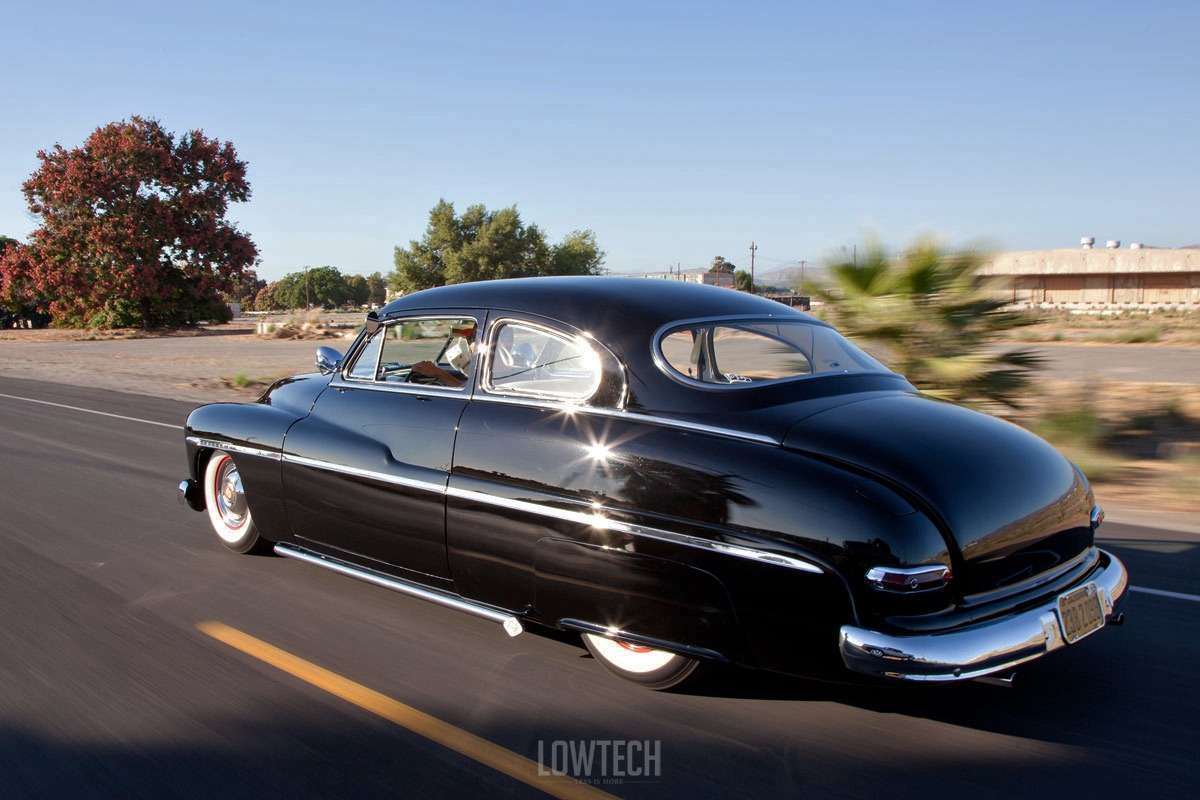
Chris Rubio’s 1950 Mercury Coupe might be the perfect example for this. It looks stunning from every angle with its flawless black paint, great stance, and subtle body modifications.


And it hasn’t even been chopped.


We don’t know exactly if this is true, but there’s a saying that there are more Mercury Coupes with a chopped top than original uncut ones. Chris couldn’t confirm this either, but he knew what he wanted when he was looking for a Merc: »I had to find an unchopped, subtlety done, traditional Merc.«


And believe it or not, it took him three years until he came across the one you see on this page: »The car was listed on eBay by a private seller. It was in January 2003 and I drove from Southern California to Las Vegas to take a look at it. The photos and description caught my eye and it seemed to be exactly what I had been looking for.«


When Chris saw the Coupe in person, he was blown away. Not like most people when they see the car from an ad for the first time. It was one of those moments when the pics don’t do the car justice – but in the most positive way possible: »The body was straight with absolutely no rust. And the seller had all the documentation from the restoration down to the last bolt. It was too good to pass up!«


Since the seller of the car, Chuck Fischer, already had bought the Mercury from a previous party, the Mercury’s history is mostly in the obscure. But whoever did the body work and paint on that car, did an outstanding job.


The black enamel paint, even after more than 20 years, still offers a mirror-like finish that seems to be deeper and glossier than many recent builds.


This is even more impressive when you know that Chris drives the car a lot: »I took it to Viva Las Vegas for several times and I usually attend the West Coast Cruising Nationals in Santa Maria. This is definitely not a trailer queen.«


One of the key factors of building a kustom is to make it look like it hadn’t been modified at all – or to leave people guessing what’s been done to it in order to make it look that cool. So, even though this Merc’s roof is untouched, the Coupe still got quite a few body modifications.


It was nosed and decked, the door handles were shaved, the headlights frenched, and the grille treatment is one of the most traditional kustom touches on a Mercury. It’s a beautiful early 1950s DeSoto grille with its signature chrome teeth.


Another thing Chris is really happy about is the stance: »It had to be low, but I didn’t want airbags. So, in my opinion, the way this Mercury sits is perfect. And it is still driveable.«


According to the previous owner Chuck Fischer, the chassis build caused quite a lot of headscratching: »Mr Fischer told me the suspension, stance and smooth ride took a lot of thought. Especially since he didn’t want to bag it.« The solution was a Camaro sub frame, combined with 2” dropped spindles. The rear was lowered using 3” blocks and modified leaf springs. Steering clearance is perfected with Fatman narrowed tubular upper and lower control arms.


The engine was also chosen because the previous owner, just like Chris, wanted the Mercury to be driveable. With the trusty 305 ci. Small block Chevy, the black sled is the perfect cruiser. Chris only added a pair of Olds Rocket style valve covers and a pin striped Caddy air cleaner for a more period look. And with those flame throwers hooked to the dual exhaust, Chris never has to worry about people tailgating when cruising down the 405.


With this Merc, Chris didn’t only accomplish his goal of having a slick sled. He’s also following a decades old family tradition: »My dad had a 47 Ford in high school and a lowered Black 56 Chevy when I was just a kid. He was in a car club called the East L.A. Road Knights. When I was about 9, I had a friend whose dad had a couple of early Chevys that he was always working on. He finished one of the cars and I remember riding in it to an indoor car show. I was instantly hooked. I thought, someday I would own one of these sweet rides.«


And even Chris’ mom contributed her part to the black Mercury: She hand made the Fuzzy Dice that’s hanging from the review mirror, using balsa wood and then crocheting the cover. A nice and personal finishing touch to this ultimate mild kustom.

2016-02-16

highway 101


Take a drive baby up the coast, yeah highway 101
I'll pass Ventura and Santa Barbara too, just as fast as my motor runs
Gotta pocket full of memories, some happy and some are sad
Gotta girl standing by my side through the good times and the bad.

Listen to the boulevard, listen to the falling rain,
I believe in love now, with all of its joys and pains.

© Social Distortion